Game-Changer for Tokenization: Fed, FDIC & OCC Declare Capital Rules "Technology Neutral"
What is a tokenized security? A tokenized security is a traditional financial instrument (such as a stock, bond, or fund) represented digitally on a blockchain or distributed ledger technology (DLT), where ownership rights are recorded and transferred using tokens. It confers the same legal rights as its non-tokenized counterpart when eligible under applicable laws. This format enables faster settlement and programmability while maintaining the underlying asset's characteristics.
Benefits of Tokenization
- Reduces operational costs through automated processes, lower intermediaries, and streamlined settlement on blockchain.
- Enhances cross-border trade by enabling near-instant, 24/7 transfers with reduced friction and currency conversion hurdles.
- Improves risk mitigation via immutable records, better transparency, and potential for real-time auditing, lowering fraud and counterparty risks.
The Previous Roadblock
Banks faced uncertainty about whether holding tokenized securities would trigger higher risk-based capital requirements or additional buffers under existing rules. The lack of explicit guidance created hesitation, as tokenization on blockchain raised concerns over technology-specific risks. This deterred institutional adoption despite growing interest in tokenized real-world assets (RWAs).
Breaking News: What Is Permitted Now?
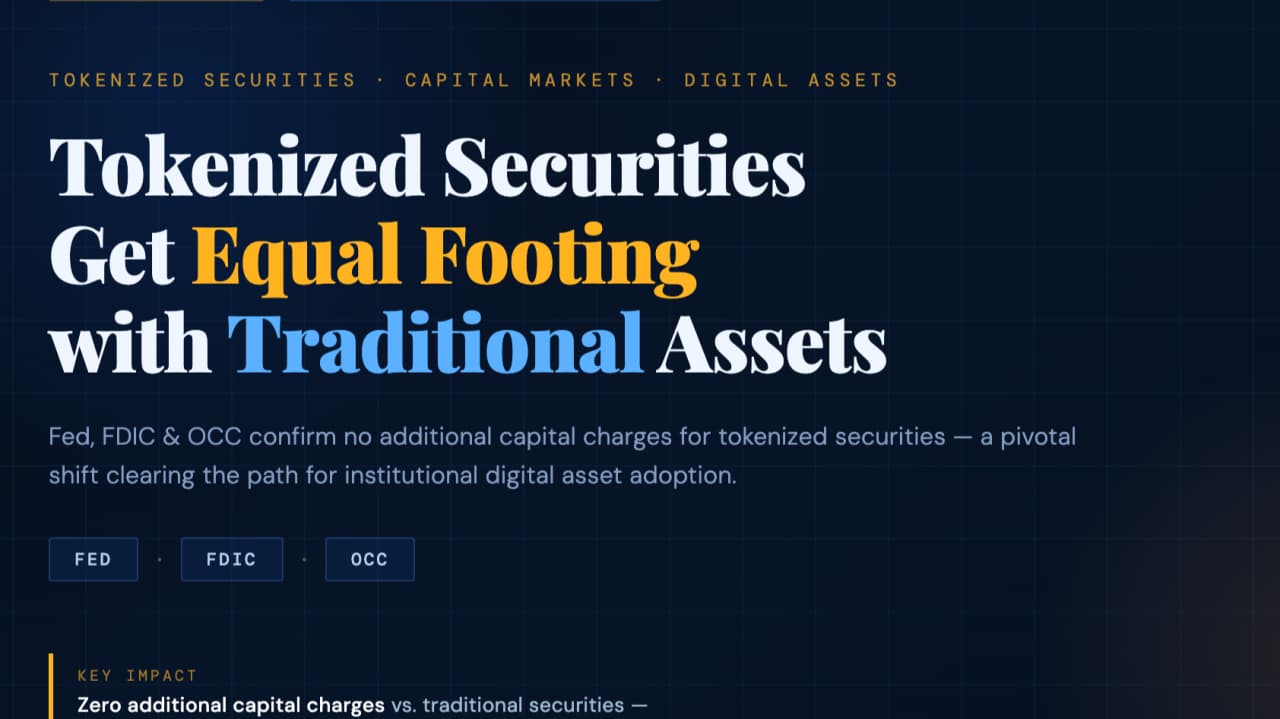
On March 5, 2026, the Federal Reserve, Federal Deposit Insurance Corporation (FDIC), and Office of the Comptroller of the Currency (OCC) jointly clarified that eligible tokenized securities receive identical capital treatment to their non-tokenized versions. The capital framework remains technology-neutral, applying the same rules regardless of whether the securities are on permissioned or permissionless blockchains. Tokenized securities can also qualify as financial collateral under existing criteria, with no extra penalties.
Who Can Issue and Hold Tokenized Securities?
Issuers of traditional securities (corporations, funds, or governments) can now tokenize them, provided they comply with federal securities laws and maintain identical legal rights. Banks supervised by the Fed, FDIC, and OCC can hold, trade, and use tokenized securities without capital disadvantages. This opens the door for regulated entities and blockchain-integrated platforms.
This technology-neutral stance removes a major barrier and boosts confidence for banks to engage with blockchain-based assets.
Summary & Impact
The March 5, 2026 joint guidance removes a key regulatory uncertainty by confirming that tokenized securities face no additional capital charges compared to traditional ones. This accelerates institutional adoption in the growing tokenized real-world assets sector and aligns with broader U.S. progress toward mainstream blockchain finance.
A significant step forward for the tokenization of traditional finance. This could unlock trillions in value by making blockchain integration capital-efficient for banks.
What do you think — will this guidance be enough to drive meaningful bank participation in tokenized assets, or are more regulatory steps still needed?