Japan's Yield Shift: Why the End of the Yen Carry Trade Could Matter for Crypto
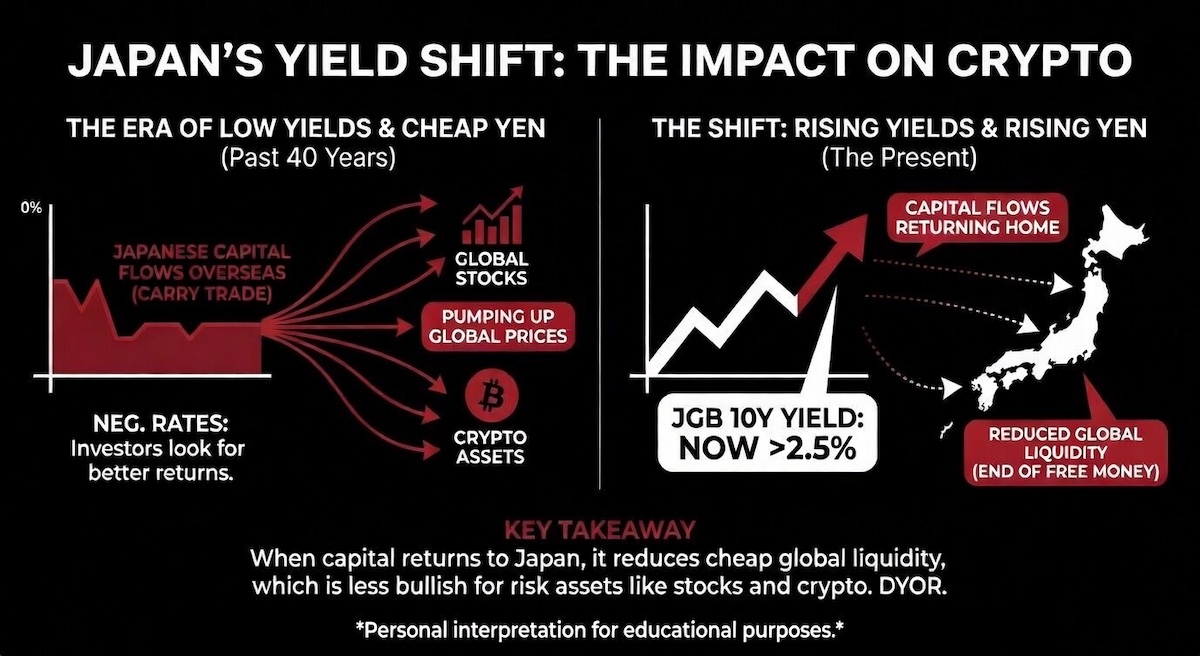
This is the 10-year Japanese Government Bond yield.
Why Does This Matter for Crypto?
Japan's economy experienced a strong boom in the 1970s. However, the country has been battling deflation since the late 1980s.
Interest rates fell dramatically and remained near zero or in negative territory for decades.
With negative rates in place, Japanese investors faced a situation where banks effectively charged them to hold cash. As a result, many sought better returns elsewhere.
Domestic stocks offered limited growth due to deflation, so capital flowed internationally in search of higher yields.
This dynamic gave birth to one of the largest and longest-running carry trades in history — the Yen carry trade.
For the past 40 years, Japan has served as a major global liquidity provider. The highly liquid Japanese Yen helped elevate asset prices worldwide, including stocks and cryptocurrencies.
The Situation Today
Interest rates in Japan are no longer negative. Yields have been rising rapidly, and the 10-year Japanese Government Bond yield has now crossed 2.5%.
As domestic returns become attractive again, Japanese investors have less incentive to send capital overseas. This has started a gradual repatriation of Yen from international markets, reducing global liquidity.
The era of abundant "free money" is slowing down.
Japanese investors were previously content with very low domestic returns (around 1%) because they had been dealing with negative rates for so long. Now, with positive yields available at home, capital is gradually returning.
This shift is likely to have an indirect but meaningful impact on crypto and other risk assets through reduced global liquidity.
Additional Context
Japan's prolonged deflation was driven by a declining population and previous over-production. Higher interest rates are now affecting production capabilities and have contributed to rising inflation — making everyday goods more expensive in Japan.
The Japanese government has also pursued aggressive policies, including large-scale Yen creation and direct purchases of private company shares.
The Yen carry trade quietly fuelled 40 years of global risk appetite. As capital repatriates home, global liquidity tightens — and that is generally less bullish for high-risk assets like crypto.