Ethereum's Path to Mass Adoption: Vitalik Buterin's Bold Execution Layer Overhaul & The Scaling Math Behind It
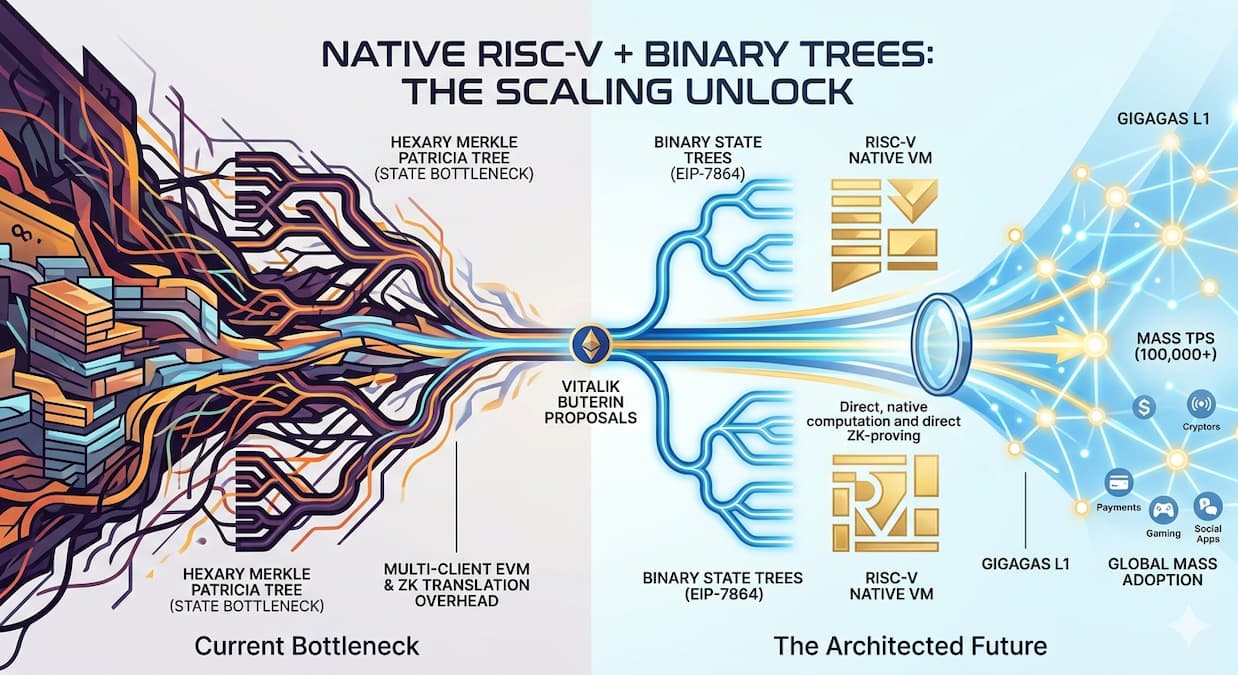
Ethereum has powered trillions in value through DeFi, NFTs, and beyond, but scalability remains the single biggest barrier to true mass adoption. High fees during congestion, slow L1 throughput (~15–30 TPS native), and expensive zero-knowledge (ZK) proofs limit everyday use cases — from micropayments to consumer apps — while pushing most activity to Layer-2.
In recent proposals (April 2025 onward, with 2026 roadmap updates), Vitalik Buterin targets the root bottlenecks: the state tree and execution layer (EVM), which together drive >80% of ZK-proving costs. His vision: binary state trees (EIP-7864) + replacing the EVM with Reduced Instruction Set Computer RISC-V as the long-term native VM.
Why the EVM Is Now the Bottleneck
Launched in 2015, the EVM's high-level, stack-based design prioritized safety and multi-client consensus — brilliant for bootstrapping decentralization. But in a ZK-dominated era:
- ZK-rollups/provers must translate EVM bytecode into lower-level formats (often RISC-V) for efficient proof generation.
- This translation overhead dominates proving time (~50–60% in benchmarks from Succinct zkEVM data).
- Result: high costs, slow finality, and limits on how much activity Ethereum can settle securely and affordably.
The execution layer + state tree are the core scaling chokepoint — not just data availability or rollups alone.
The Proposed Fixes
- Binary State Trees (EIP-7864) — Replace the hexary Merkle Patricia tree with a binary structure → ~75% shorter Merkle proofs → dramatically lower proving/verification overhead.
- RISC-V as Native VM — Open-source, register-based ISA (like modern CPU instructions):
- New contracts compile directly to RISC-V (via Solidity/Rust backends).
- Eliminates the EVM translation middleman → 50–100× cheaper/faster ZK proofs in many cases.
- Simpler spec → easier audits, smaller clients, better JIT/native performance.
- Legacy EVM preserved forever via on-chain interpreter (Rosetta-style compatibility).
Combined, these target the proving bottleneck head-on, enabling validators to handle more computation without exploding hardware requirements.
Projected Scaling Impact & Mass Adoption Angle
No single upgrade delivers "infinite TPS" overnight — Ethereum's roadmap is layered (L2 rollups + blobs + execution improvements). But the math points to transformative gains:
- Near-term (2026 upgrades like Glamsterdam/Hegotá): Higher gas limits, parallel execution, blob scaling → modest L1 boosts + cheaper L2 settlement.
- With binary trees + RISC-V (longer-term, 5–10+ years):
- Proving costs down 50–100× → enables client-side/validator proving at scale, reducing reliance on centralized sequencers.
- Gigagas L1 vision (~10,000 TPS native throughput in optimistic projections from community analyses) — lower L1/L2 fees, viable for complex apps.
- Ultimate goal: 100,000+ TPS ecosystem-wide (L1 + L2s) without sacrificing decentralization — making Ethereum competitive with centralized systems for global adoption.
- Real-world bottleneck solved: Today, high ZK costs limit privacy-heavy or high-volume apps. Post-RISC-V, proofs become cheap enough for everyday use, unlocking mass onboarding (e.g., payments, gaming, social) while keeping Ethereum as the secure settlement layer.
Bottom Line: Ethereum isn't just tweaking parameters — it's architecturally evolving to remove the last major execution/proving bottlenecks. If executed well, this could deliver the low-cost, high-throughput foundation needed for billions of users, without compromising decentralization. Mass adoption isn't about one killer app; it's about making the base layer economically and technically feasible for everything else to build on. RISC-V + binary trees could be the unlock.
Critics (e.g., Offchain Labs favoring WASM) note migration risks and debate optimal VM choice, but consensus grows around fixing proving efficiency as essential.
What do you see as the biggest remaining hurdle — tech risks, timeline, or something else?
Thoughts from builders, researchers, and investors welcome!